The Local Edge: Leveraging Geographic Intelligence to Win South African Tenders in 2026
In the high-stakes arena of South African procurement, winning isn't just about what you bid, but where you bid. Discover how provincial tender data is leveling the playing field for SMMEs and driving localized economic transformation.
In the high-stakes arena of South African procurement, winning isn't just about what you bid, but where you bid. As we move deeper into 2026, the landscape of government contracting has fundamentally transformed. Standard, centralized bidding strategies are being replaced by hyper-local, data-driven approaches that allow businesses to identify and capture opportunities in specific provinces and municipalities. This 'geographic advantage' is not just a buzzword; it's a critical survival strategy for Small, Medium, and Micro Enterprises (SMMEs) aiming to compete with corporate giants.
The introduction of the Provincial Tender Heatmap has been a game-changer in this regard. By visualizing where tender activity is concentrated across South Africa's nine provinces, it removes the 'blind spots' that have traditionally hampered small business growth. Instead of chasing oversaturated markets in Gauteng, savvy entrepreneurs are now using this intelligence to find 'green zones'—areas where government spending is high but local supplier competition is manageable. This shift is not only good for business; it is a foundational pillar of localized economic development, ensuring that state expenditure reaches every corner of the country.
The Dawn of Data-Driven Localization
For decades, the South African procurement landscape was dominated by a handful of large corporations that had the resources to track every tender manually. SMMEs, on the other hand, were often relegated to their immediate geographic vicinity, missing out on massive opportunities just across provincial borders. The result was a highly centralized economic model where wealth and infra-structural development were concentrated in urban hubs, leaving rural and outlying areas underserved.
However, the 2024 Public Procurement Act and subsequent regulations have mandated a more decentralized approach. Provincial and local authorities now have greater autonomy to tailor their procurement policies toward specific regional economic goals. This has created a vibrant, albeit complex, patchwork of opportunities. To navigate this patchwork, businesses need more than just a list of tenders; they need a strategic map. This is where geographic intelligence comes in. By analyzing provincial spending patterns, businesses can align their core competencies with the developmental priorities of each region, whether that's agri-processing in the Free State, mining support in Limpopo, or tourism infrastructure in the Eastern Cape.
Breaking the Gauteng Monopoly
Historically, Gauteng has been the default destination for any business seeking government contracts. It makes sense on paper: with the highest concentration of government departments and state-owned enterprises, it represents the largest slice of the R500 billion annual procurement pie. But the Provincial Tender Heatmap reveals a more nuanced reality. While Gauteng's 'intensity' is often high, so too is the intensity of competition. For a mid-sized supplier, bidding in Gauteng can be like trying to shout in a crowded stadium—your message (and your proposal) often gets lost in the noise.
Contrast this with provinces like the Northern Cape or the North West. While the absolute number of tenders might be lower, the 'competitive density' is significantly more favorable. Using the heatmap tool, a business might discover that while there are 500 active tenders in Gauteng, there are 80 in Limpopo specifically focused on infrastructure maintenance—a sector they excel in. By shifting their focus to these 'intensity pockets,' businesses can achieve much higher win rates, build deeper relationships with local procurement officials, and ultimately, secure more sustainable growth paths.
The Three Pillars of Geographic Strategy
Developing a geographic strategy for 2026 requires a focus on three key pillars: Resource Optimization, Compliance Specialization, and Strategic Relationship Building.
1. Optimized Resource Allocation
Every tender bid represents a significant investment of time and money. For many SMMEs, the cost of preparing a professional, compliant bid can range from R15,000 to over R50,000 when factoring in staff time, certification costs, and professional advice. Chasing the wrong tenders is a luxury most small businesses cannot afford. Geographic intelligence allows you to 'pre-qualify' opportunities. If the heatmap shows a surge in healthcare tenders in KwaZulu-Natal, a medical supply company can double down on that region, focusing their entire research and preparation team on winning a specific cluster of contracts rather than spreading themselves thin across unrelated provinces.
2. Compliance and Local Content Specialization
In 2026, the 'Local Content' requirement is no longer a generic national target; it is a localized mandate. Winning a tender in Durban often necessitates proving that a certain percentage of your labor or raw materials comes from within the eThekwini municipality. Similarly, different provinces emphasize different B-BBEE sub-categories. One province might award higher 'premium points' for youth-owned businesses, while another focuses on military veterans. The heatmap and its associated tools allow you to map your own compliance profile against these regional variances, identifying where your existing business structure gives you a 'native' advantage.
3. Strategic Relationship Building
Despite the digital transformation of procurement, it remains a human-centric process at its core. Identifying a province with high tender volume but low competition is only the first step. The second step is building a legitimate presence in that area. This doesn't always require a permanent office; often, it can be achieved through strategic joint ventures with local partners. By using the heatmap to identify these strategic entry points, businesses can be proactive rather than reactive, building trust with local stakeholders long before a specific tender even hits the market.
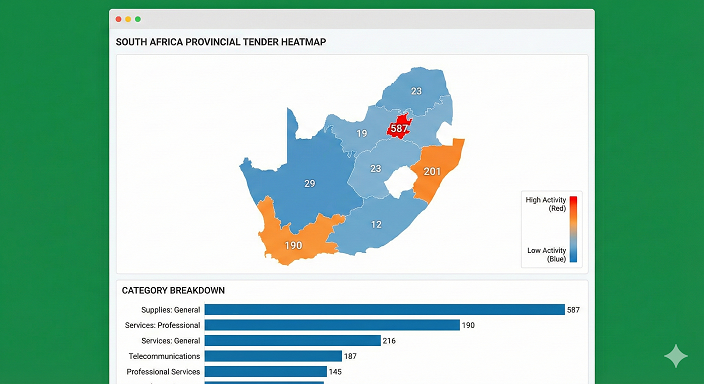
Figure 1: The Provincial Tender Heatmap helps businesses visualize where tender activity is concentrated, allowing for smarter, data-driven bidding strategies.
Unlocking Underserved Markets: A Case for the Northern Cape
The Northern Cape provides a classic example of why geographic intelligence is crucial. Traditional tender alerts might show a few large-scale renewable energy projects, which often feel out of reach for smaller contractors. However, when viewed through the lens of the Provincial Tender Heatmap, a different picture emerges. The primary energy projects create a massive secondary 'aftermarket' for maintenance, logistics, and professional services.
A business using the heatmap to track activity in the Northern Cape would see clusters of activity not just in major towns, but in specific municipalities where energy infrastructure is being built. By identifying these clusters early, a supplier can position themselves as the local 'go-to' expert. This first-mover advantage is almost impossible to break once established, providing a stable revenue stream for years. This is how data turns a high-risk bid into a low-risk business expansion.
Leveraging Technology for Competitive Edge
In 2026, the technology behind tools like the Provincial Tender Heatmap has become incredibly sophisticated. It's no longer just about current data; it's about historical trends and predictive modeling. By looking at how provincial heat patterns have shifted over the last 24 months, businesses can predict when a specific department's budget is likely to be released. This allows for 'pre-emptive preparation'—starting your compliance checks and partner searches months before the tender is officially published.
"
Checklist: Developing Your Provincial Strategy
Ready to move beyond your current market? Follow this checklist to build a data-driven provincial strategy:
- undefined
- undefined
- undefined
- undefined
- undefined
Pro-Tip: Monitoring the 'Green Zones'
Watch for provinces that show a steady transition from light to dark colors on the heatmap over a 3-month period. This usually indicates a major provincial growth program is gaining momentum. This is the optimal time to reach out to local business chambers and identify subcontracting opportunities before the market becomes saturated.
Summary Table: Navigating Provincial Tenders in 2026
| Market Type | Intensity Level | Typical Competition | Strategic Approach |
|---|---|---|---|
| Economic Hubs (Gauteng, WC) | Extremely High | Dozens of large-scale firms | Specialization & Niche Services |
| Growth Frontiers (EC, KZN) | High | Balanced mix of local & national | Local Content & SMME Partnerships |
| Strategic Margins (NC, FS, NW) | Moderate | Low competition, high margins | First-Mover & Relationship Building |
| Developmental Hubs (LP, MP) | High (Cluster-based) | Sector-specific intensity | Targeted Industrial Support |
Conclusion: A Vision for Integrated Growth
The future of South Africa's economy depends on our ability to distribute opportunities fairly across every province. Geographic intelligence is the engine that drives this distribution. By using tools like the Provincial Tender Heatmap, businesses are doing more than just winning contracts; they are becoming partners in national development. They are ensuring that a hospital in Limpopo has the same quality of equipment as one in Sandton, and that a school in the Northern Cape is built by the most capable, dedicated contractors.
As we navigate the complexities of 2026, let data be your guide. Stop bidding in the dark and start leveraging the geographic advantage. The map is drawn, the data is live, and the opportunities are waiting. It’s time to find your 'green zone' and build the future of your business.
At Tenders-SA.org, we are committed to providing the intelligence and the tools you need to succeed. Our platform is designed to simplify the complex and turn data into contracts. Visit us today to explore the Provincial Tender Heatmap and start your journey toward smarter, more successful tendering.
Tags
Based on this article's topics, here are some current tenders that might interest you
Request for tenders for the appointment of appropriately skilled contractors for the construction of an apple juice plant top structure including all related external works and services at the Maluti-A-Phofung Special Economic Zone in Tshiame, Harrismith South Africa
Appointment of a contractor for the construction of hotel rooms, conference center, parking area, associated external works and refurbishment of a boma facility at Nylsvlei Nature Reserve on behalf of Limpopo Economic Development Environment and Tourism - WORK PACKAGE A
APPOINTMENT OF SERVICE PROVIDER TO PROVIDE TRAINING IN LOCAL ECONOMIC DEVELOPMENT (NQF LEVEL 6
THE APPOINTMENT OF A SERVICE PROVIDER FOR THE PROVISION OF OCCUPATIONAL HYGIENE SERVICES IN THE DEPARTMENT OF ECONOMIC DEVELOPMENTE AND TOURISM FOR (RIVERSIDE GOVERNMENT COMPLEX, MBOMBELA SQUARE AND EMALAHLENI OFFICES) FOR A PERIOD OF THIRTY-SIX (36) MONTHS
REQUEST FOR PROPOSAL FOR THE PROVISIONING OF PHYSICAL SECURITY (GUARDING) SERVICES AT THE OR TAMBO INTERNATIONAL AIRPORT SPECIAL ECONOMIC ZONE PRECINCT 1 AND PRECINCT 2 FOR A PERIOD OF SIXTY (60) MONTHS
Want to see all available tenders?
Browse All Tenders →Share this article
The Local Edge: Leveraging Geographic Intelligence to Win South African Tenders in 2026
In the high-stakes arena of South African procurement, winning isn't just about what you bid, but where you bid. Discover how provincial tender data is leveling the playing field for SMMEs and driving localized economic transformation.