Deep Analysis: How AI Scans 100+ Page Tender Docs for You
Don't get lost in the fine print. Discover how our Gemini-powered Deep Analysis service extracts key mandatory requirements and evaluation criteria in seconds.
The Challenge of the 'Fine Print'
In South African public procurement, a single tender document can easily range from 50 to 200 pages. For an SMME owner, finding the specific 'Evaluation Criteria' or the list of 'Mandatory Returnable Documents' can take hours of painstaking reading. Our Gemini Analysis Service changes the game by using advanced Large Language Models to 'Deep Scan' every page for you.
Anyone who has actually opened one of these documents knows the shape of the problem. The requirements you actually need are rarely on page one. They're scattered across annexures, buried in tables that reference other tables, and sometimes repeated with slightly different wording in two different sections of the same document. A business owner reading in the evening after a full day of running operations is exactly the person most likely to miss a subtle but disqualifying detail—not because they aren't careful, but because the format of the document works against careful reading rather than for it.
The Anatomy of a Deep Scan
When a tender is published, our system doesn't just store the PDF; it passes it through the gemini-analysis.service.ts pipeline. This service performs a multi-dimensional extraction to find high-stakes data points that standard search engines miss.
The distinction between 'storing' a document and 'analysing' it is the whole point. A conventional tender portal treats a PDF as a static file to download—the equivalent of handing you a stack of paper and wishing you luck. Deep Analysis instead treats the same PDF as a structured source of facts waiting to be organised: who is buying, what they need, how they'll judge submissions, and what could get a bid thrown out before it's even scored. That reframing, from document to structured data, is what allows an SMME owner to get a usable answer in minutes rather than hours.
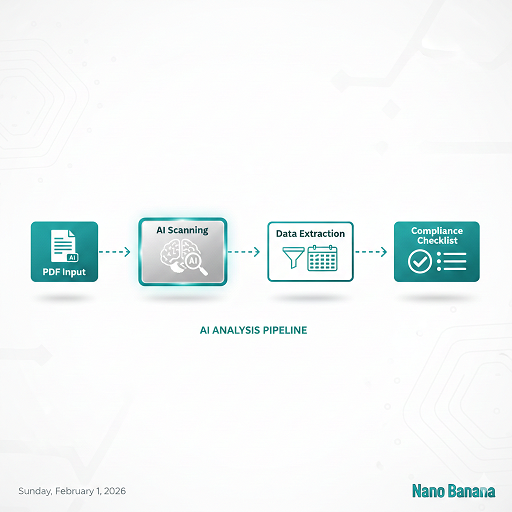
From Raw PDF to Structured Compliance Data: The 4-Step Analysis Pipeline.
What the AI Extracts for You
Our AI looks for the 'critical failure points'—the things that usually get businesses disqualified. Based on our analysis of the codebase, here are the primary data fields the AI hydrates for every analyzed tender:
- Submission Guidelines: Step-by-step instructions on where and how to submit, including physical vs. digital requirements.
- Evaluation Criteria: A breakdown of how your bid will be scored (e.g., 80/20 or 90/10) and specific functionality thresholds.
- Financial Requirements: Minimum turnover, insurance levels, and financial statements required.
- Compliance Pillars: Extraction of required certificates (BBBEE, COIDA, Tax Clearance, CIDB).
- Important Dates: Automated detection of briefing sessions, site visits, and clarification deadlines.
Each of these fields corresponds to a specific way that bids commonly fail before they're even evaluated on merit. Submission guideline mistakes—submitting a digital copy when a physical, sealed envelope was required, or missing a mandatory briefing session—disqualify bids that might otherwise have scored well. Evaluation criteria confusion leads businesses to over-invest in the wrong part of their proposal, polishing a section worth 10% of the score while neglecting one worth 40%. Financial requirement mismatches waste hours preparing a bid the business was never eligible for. Compliance gaps are perhaps the most common and most avoidable failure point of all: a missing tax clearance certificate or an expired BBBEE certificate can sink an otherwise excellent submission. And missed dates—especially mandatory site visits—can disqualify a bid regardless of how strong the rest of the submission is.
From Raw Text to a Go/No-Go Decision
Picture a small facilities management company weighing up whether to pursue a 120-page tender for cleaning and grounds maintenance services at a group of provincial hospitals. Reading the whole document manually before deciding whether it's even worth bidding could easily consume the better part of a working day. With Deep Analysis, the owner can instead open the tender page and see, within moments, the minimum turnover requirement, the required certifications, the evaluation weighting between price and functionality, and the date of the mandatory site briefing—laid out clearly rather than scattered across a hundred pages. If the turnover threshold or a required certification immediately rules the business out, that's a decision made in minutes rather than after a wasted afternoon of reading.
Bridging the Language Gap
One of the most powerful features of our AI is its ability to fix poorly written tender titles and summaries. Many government tenders are uploaded with cryptic titles like 'RFQ-001-KZN'. Our AI uses the document's content to generate a clear, SEO-friendly title that actually tells you what the project is about (e.g., 'Supply and Delivery of Medical PPE to KZN Health Clinics').
This might sound like a small convenience, but it changes how discoverable a tender actually is. A cryptic reference code means nothing to a search engine, and it means nothing to a business owner scanning a list of dozens of opportunities. A clear, descriptive title turns an opaque code into something a human can recognise as relevant to their business at a glance—which is often the difference between an opportunity being noticed at all and it being scrolled past unread.
Using Deep Analysis Alongside Your Own Due Diligence
Deep Analysis is designed to accelerate your reading, not replace it entirely. The AI is very good at surfacing where the important sections live and summarising what they say, but the final responsibility for compliance always sits with your business. Before you submit any bid, it's worth treating the AI's extracted requirements as a guided starting point and then confirming the specific clauses yourself, especially around submission mechanics and mandatory documents, since a misread deadline or a missed briefing session can be an unrecoverable mistake regardless of how strong the rest of your proposal is.
Why Manual Reading Alone No Longer Scales
It's worth stepping back to consider why this problem has grown rather than shrunk over time. As public bodies push more procurement online and as reporting and compliance obligations multiply, tender documents have generally grown longer and more detailed, not shorter. A single 200-page document is no longer an outlier; it's increasingly the norm for larger infrastructure and services contracts. For a business bidding on even a handful of opportunities a month, manually reading every page of every candidate tender simply doesn't scale against the other demands of running a company. Deep Analysis exists precisely because the volume and complexity of procurement documentation has outpaced what any one person can reasonably read cover to cover on top of everything else their job requires.
How This Changes the Economics of Bidding
There's a second-order benefit that's easy to overlook: faster disqualification decisions are just as valuable as faster qualification decisions. A business that can determine in ten minutes that it doesn't meet a minimum turnover threshold has saved itself the cost of a wasted bid-writing effort that might otherwise have consumed days. Multiply that across a year of tender opportunities, and the time saved by fast, accurate Go/No-Go decisions compounds into meaningfully more capacity to chase the opportunities that are actually winnable. In that sense, Deep Analysis isn't only about reading faster—it's about allocating your limited bidding capacity toward the contracts where you have a genuine chance.
Conclusion
Information overload is the enemy of a successful bid. By using AI to decode complex documents, Tenders-SA.org empowers businesses to make faster 'Go/No-Go' decisions. Don't waste time on tenders you aren't eligible for—let the AI do the heavy lifting so you can focus on writing your winning proposal.
Tags
Based on this article's topics, here are some current tenders that might interest you
Tender to appoint service provider(s) for electrical services -maintenance, repairs and replacement of electrical equipment, installation work, issuing of electrical certificates of compliance in City of Tshwane buildings and facilities for a period of three years as and when required
APPOINTMENT OF SERVICE PROVIDER FOR THE PROVISION OF A GOVERNANCE, RISK AND COMPLIANCE (GRC) SOFTWARE SOLUTION INCLUDING INSTALLATION, MAINTENANCE AND SUPPORT FOR A PERIOD OF THREE (3) YEARS
Appointment of an Electrical Contractor for Electrical Repairs, Maintenance, Alterations, Installations, Compliance and Electrical Emergency services for a period of Three (3) years
The appointment of Accredited Service Providers for Spazashop Registration, Compliance Support, Business Licence Audit/Enforcement, Training and Partnership Optimization within the City of Ekurhuleni on an as and when required basis from date of award until 30 June 2029
Design, Supply, Delivery, Installation and Certification of Compliance of Concrete Columns, Shipping Container and Concrete Slabs
APPOINTMENT OF A SERVICE PROVIDER TO PROVIDE PRODUCTION PROCESS-FLOW AUDITING/ASSESSMENT AND COMPLIANCE TRAINING FOR THE IMPLEMENTATION OF THE “AGRO-PROCESSING MARKET COMPLIANCE/STANDARDS PROGRAM FOR THREE (3) MONTHS
Want to see all available tenders?
Browse All Tenders →Share this article
Deep Analysis: How AI Scans 100+ Page Tender Docs for You
Don't get lost in the fine print. Discover how our Gemini-powered Deep Analysis service extracts key mandatory requirements and evaluation criteria in seconds.